

Friday March 1,
11:00 AM – 12 Noon

Friday March 1,
3:00 PM – 4:00 PM
Saturday March 2,
11:00 AM – 12 Noon
Saturday March 2,
3:00 PM – 4:00 PM
Sunday March 3,
2:00 PM – 3:00 PM
Cursive letters make sense with CursiveLogic
CursiveLogic is different from other handwriting methods. Instead of relying on rote memorization, CursiveLogic teaches the essential structure of the cursive alphabet. The CursiveLogic instruction method has two key features:
CURSIVE LETTERS GROUPED BY SHAPE
Four basic shapes make up the entire lowercase alphabet. Teaching similarly shaped letters together in one lesson streamlines and shortens the learning process.

CURSIVE LETTER STRINGS
Rather than teaching letters one at a time, CursiveLogic teaches all the letters that share a common shape as a connected string. Writing similar letters as a connected string allows proper formation of each letter to reinforce proper formation of every other letter in the string. Learning the letters in strings also means that students are writing cursively from the very beginning. Students never write disconnected letters in CursiveLogic.

FEATURES THAT ENGAGE
CursiveLogic engages every learning style by seamlessly combining visual, auditory, verbal, and kinesthetic elements. CursiveLogic makes it possible for every student to succeed and enjoy the process.
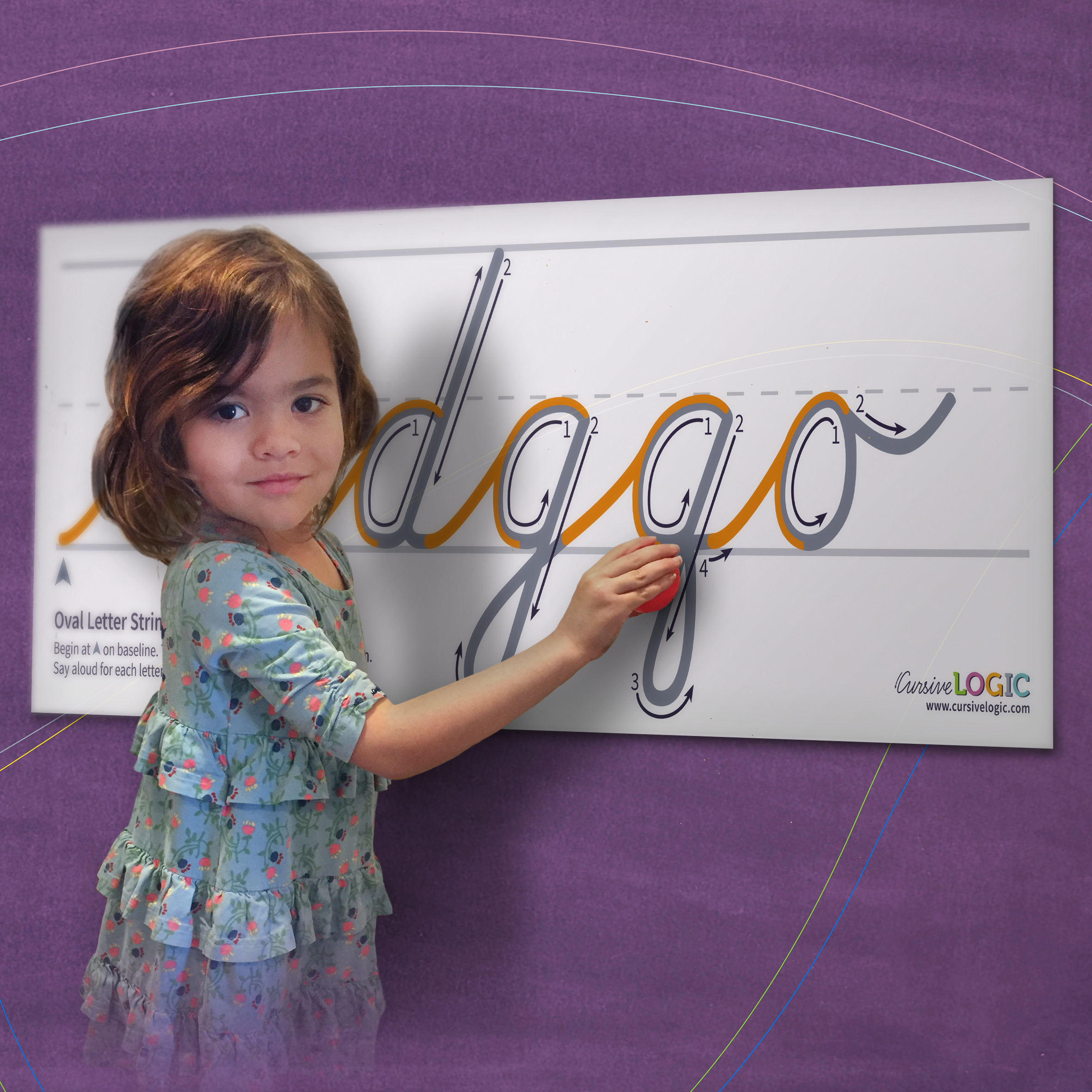
COLOR — Each CursiveLogic shape category has a theme color that aids learning and reinforces memory. Bright orange, lime green, silver, and mauve capture students’ attention. Using colored pencils and pens can add even more to the learning and the fun.
CATCH PHRASE — Each shape category has a “catch phrase,” which is a verbal cue that students repeat while forming the letter strings. Verbal task analysis, or speaking out an action while performing it manually, solidifies muscle memory. It also provides a mnemonic to associate with each letter. Students repeat the catch phrases any time they need help forming a letter.
MOVEMENT — CursiveLogic uses the core principle of muscle memory. Finger tracing exercises and gross motor activities help students internalize correct formation of the four basic CursiveLogic shapes and letter strings.
LOGIC — CursiveLogic shows students the big picture in a way they understand easily. When the system “clicks,” cursive letters no longer seem random. Students “get it” and feel empowered.
REAL WORDS — Because CursiveLogic teaches six connected letters in the first lesson, students can write real words in cursive at the end of just one week. Immediate payoff is exciting and motivating! Cursive no longer feels like a daunting or frustrating task. Instead, cursive engenders confidence and feelings of success!
“Students who didn’t enjoy cursive before began to love showing off their new skill! Many students were surprised at how many of the letters were formed beginning with similar movements. That gave them the confidence to keep going!— 4th Grade Teacher, Tulsa, OK

“I like the chanting that goes along with each stroke. …This is a great tool to use for my fourth graders! They were all chanting the strokes at the same time as they were writing the letters. What a great method!”

OUR STORY
How CursiveLogic Started
In 2010, CursiveLogic founder Linda Shrewsbury was volunteering in a local literacy program as a reading tutor for Josh, a 23-year-old student with learning disabilities. One day, Josh told her that he wanted to learn cursive so he could sign his name. Linda’s first thought was, “At his age, Josh doesn’t have time to learn penmanship the way grade school kids do—letter by letter, day by day, for months.” And she didn’t see that process boosting his ego either. It was such a simple wish. Linda was touched and determined to find a way to help.
“Could you teach me cursive? I’d like to be able to sign my name. — Josh, First CursiveLogic Student
Linda wanted to shorten the cursive-instruction time frame. At home, she wrote the lowercase cursive alphabet on a large sheet of paper and just looked at the letters for a long time. As she studied the letters, Linda saw a pattern she hadn’t noticed before. Each letter seemed to fit into one of four distinct categories. Linda wondered if seeing this pattern would help Josh. Maybe learning small variations on a few shapes would feel less overwhelming than the chore of practicing 26 individual letters.
When Linda explained the patterns to Josh, his response was intuitive and fast. He caught on to forming the entire lowercase alphabet in 45 minutes and became so enthusiastic about his success that learning his uppercase initials was easy. After just one session, Josh signed his name.
After teaching more students from many different background all with similar results, Linda realized she had created a greatly simplified way to help students master cursive handwriting. Learning cursive doesn’t have to be tedious. Instead, students can quickly feel the satisfaction of signing their names in beautiful, cursive letters.
We hope CursiveLogic helps you and your student as much as it helped Josh.

WHY CURSIVE?
Importance of Cursive
Some may wonder why students should learn to write in cursive in the age of tablets and iPhones. Won’t everyone just be typing and dictating in the future? While electronic devices have added an element of convenience to the writing process, evidence is mounting that putting pen to paper has benefits that typing cannot replace. Researchers have found ties between writing by hand and everything from language skills to memory to critical thinking.
“Evidence is mounting that putting pen to paper has benefits that typing cannot replace.
HANDWRITING VS. TYPING
In a recent study entitled “The Pen is Mightier than the Keyboard,” researchers Pam Mueller and Daniel Oppenheimer found that students who take notes by hand perform better on conceptual questions than students who take notes on laptops. They concluded that students who type their notes tend to transcribe the lecture and to process the lecture only on a shallow level. Student who take notes by hand actually digest the content and reframe it in their own words—a process that increases both understanding and recall.
THE IMPORTANCE OF HANDWRITING TO WRITING QUALITY
By analyzing numerous studies, researchers Steve Graham and Tanya Santangelo found that teaching handwriting is strongly correlated to improvement in the quality of writing (not just the legibility of the handwriting, but the quality of the composition).
The writing process involves a number of “low-level” skills—such as handwriting, spelling, and grammar—along with a number of “high-level” skills—organization, strategy, considering the parameters of the topic and the needs of the reader, etc. When students aren’t proficient at the low-level skills and have to work hard just to get words onto the paper, they don’t have enough brain power left to execute the high-level skills. But when student have fluent handwriting, they are free to concentrate on the high-level skills we associate with good writing. As Graham and Santangelo point out, even with the presence of computers, much of the writing done in primary school will necessarily be done with pencil and paper, so students who fail to develop fluent handwriting will suffer.
While the benefits of handwriting can be observed in student performance, they can also be observed in the brain itself. A study using fMRI technology showed that writing letters, as opposed to viewing them on a screen, is associated with more advanced brain function. Preliterate children who actually wrote a letter showed brain activation in areas associated with reading and writing in adults, while children who viewed the letter on a screen did not.
BENEFITS OF CURSIVE
And, according to neurologist William Klemm, the neurological benefits of writing by hand are compounded with cursive writing. “Cursive writing, compared to printing, is even more beneficial because the movement tasks are more demanding, the letters are less stereotypical, and the visual recognition requirements create a broader repertoire of letter representation.” Researcher Diane Montgomery posits that the connected letters and fluid motion of cursive handwriting are especially beneficial to students with disorders such as dyslexia and dysgraphia.
Yet many fail to recognize the value of cursive. The authors of the Common Core, regarding old-fashioned writing as antiquated in the modern age, leave little time for handwriting instruction, filling students’ and teachers’ time with other substantive subjects.
“When students write confidently and legibly, their academics as a whole seem to improve.
This focus on academic content at the expense of form has the potential to do more harm than good. When students write confidently and legibly, their academics as a whole seem to improve. And cursive is an academic skill at which everyone can succeed. At Blackshear Elementary School, a Texas school that famously revived its failing academic condition by focusing on handwriting, the teachers noted that excellent handwriting was a goal to which all students could aspire. While certain gifted students may rise to the top again and again in the academic subjects, any student can aspire to have excellent handwriting and can achieve the goal with practice.
And, for students who are struggling, success in one area can be the key to unlocking greater academic potential. As Dr. Klemm observed, “As a child learns to master academic challenges, self-confidence emerges and provides a drive to learn more because the child knows that achievement is possible. Learning cursive is an easy way for a child to discover important tactics for learning as well as the emotional benefit of being able to master a task.”
CURSIVE AND CREATIVITY
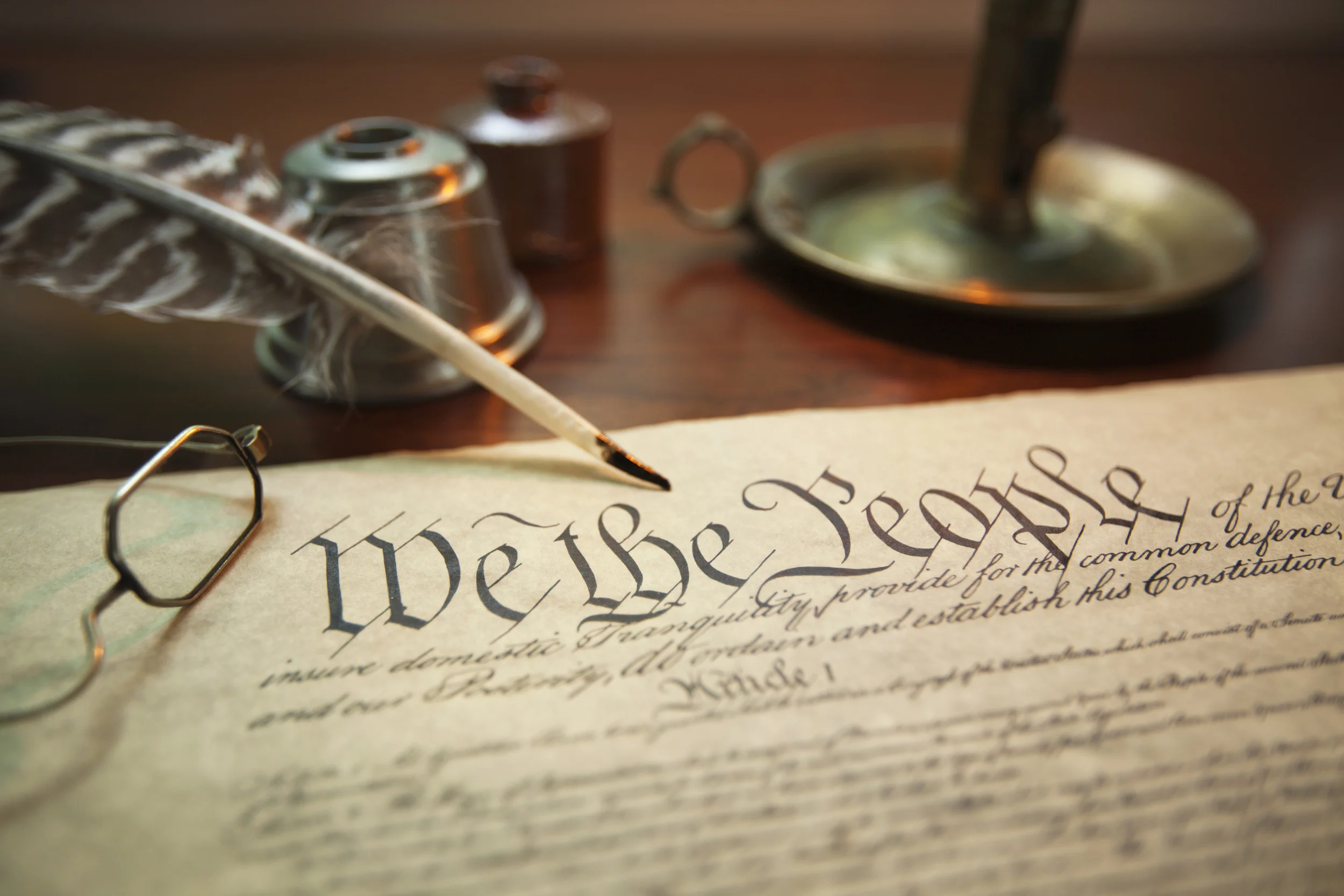
Cursive has the added benefit of being both artistic and highly personal. Children no less than adults long to express their individuality and creativity. Developing a cursive hand—epitomized in the signature and carried through in a unique form of writing that others can identify and associate with a particular individual—is an important step in developing a personal style and voice. Students are not automatons, and education should include tools that encourage the individual personality.
Flourishes—those extra pen strokes that connect, begin, and end words—differentiate printed words from words written in cursive. By making the ability to write in cursive available to everyone, CursiveLogic empowers every student not merely to learn, but to flourish.
FOUNDERS

MEET LINDA
Linda Shrewsbury is the primary author of the CursiveLogic curriculum. Linda graduated from Harvard University in 1974 with a concentration in economics. In 2007, she received a Masters in International Studies from Oklahoma State University. In addition to homeschooling her own three children for 13 years, Linda has been privileged to work as a teacher and a college professor in both private and public institutions. But CursiveLogic was not born from the ivory towers of higher learning. Linda created CursiveLogic to meet the needs of one special student who simply wanted to learn to sign his name.

MEET PRISCA
Prisca LeCroy (Linda’s daughter) is an attorney by training and the mother of five girls and one boy. She received her undergraduate degree, magna cum laude, from Harvard University in 2003 and her J.D. from the University of Virginia in 2008. Before entering the legal profession, Prisca taught math and English in a secondary school in East Africa. She now homeschools her children using Montessori and Charlotte Mason principles.
See what experts, teachers, and students who have used CursiveLogic are saying about their experiences.
Friday March 1,
11:00 AM – 12 Noon
Friday March 1,
3:00 PM – 4:00 PM
Saturday March 2,
11:00 AM – 12 Noon
Saturday March 2,
3:00 PM – 4:00 PM
Sunday March 3,
2:00 PM – 3:00 PM

Baltimore/Washington International Pen Show 2024
Enjoy the luxury of seeing pens from around the world
